Search This Blog

The Lincolnshire Pub the RAF Destroyed

The Sir Isaac Newton in the 1930s, possibly shortly before demolition

Heading north on the A46 from Newark it is almost impossible to believe there once was a public house a short distance south of the roundabout at Halfway Houses.

The pub began life at Halfway House Farm.  In 1856 the pub moved south to its final location.  It and the nearby Red Lion were well placed to serve and accommodate the weary traveller being almost exactly midway between Newark and Lincoln.

During the Lincoln Handicap it was usually granted an alcohol licence extension so the late night travelling punters could celebrate their wins and losers could get some consolation in an alcoholic drink.

Auctions and inquests were also held at the pub.

Its end came with the building of RAF Swinderby, one of the last stations completed under the RAF's expansion plans begun in the 1930s.  The pub was demolished in 1940 to make was for a dispersal point.  As a result, the tenants moved to the newly constructed Fosse Way public house on the A46 near Thorpe on the Hill, where they remained until their retirement in 1956.


1912 Ordnance Survey Map overlaid with Bing aerial view
© National Library of Scotland


Google Streetview of the location of the Sir Isaac Newton public house.  Too dangerous to stop to take a photo.

List of Licensees of the Sir Isaac Newton public House

Dates are not when they became licensee, but give a chronological indication
1841 Thomas Glazier (b1813 - d1845)
1855 Richard Glazier
1860,1861 William Bottomley
May 1870 Robert Merry becomes licensee
1872 Robert Croft
Dec 1874 W Smith becomes licensee
1896 George Makin, 1st March 1893 he was prosecuted for selling adulterated brandy.
1905 William Henry White
1909/1913 Richard Bones
1919 Mary Ann Bones
27 February 1920 the S.I.N sold by auction for £1,550. With 10 acres of Land to Mr Antill of Cleethorpe.  Was he acting as agent for James Hole?
1924 licencee W D Antill
Mar 1934 Application for extension for Lincoln Handicap, licencee A J Gardner 
Arthur Gardner was licensee of the Sir Isaac Newton and became licensee of The Fosse Way from 1940, he retired in 1956 after 43 years with James Hole's brewery.  


Lincoln's Public Library

 Prior to The Public Libraries Act of 1850 libraries were only available to subscribers, often in stationery and book shops.

The Public Libraries Act was eventually adopted by Lincoln Corporation on 21st January 1892.  The Corporation formed a Library Authority for 3 years from 9 May 1894.  To help with the costs of setting up the library  Sir Charles Seely, MP gave £1,200., The Corporation, £200 and William Crosfield, MP, £100.

The City Assembly rooms, above the Buttermarket as St Peter at Arches was converted to the library at a cost of £1,272 17s. under the supervision of the City Surveyor, Mr R A MacBrair.

Lincoln's Public Library opened on 9th May 1895 with 7,000 books and news and reading rooms with about 100 newspapers and periodicals.

By this time the Mechanics' Institute had moved from Greyfriars to the old Assembly Rooms, Guild Court, Danesgate Terrace where they provided about 20,000 books but many of these were only available to subscribers.

Within 15 years the library had outgrown the former Assembly Rooms and a committee was formed with the aim of building a new Public Library.  Andrew Carnegie, the Scottish-American industrialist, gave the City a grant of £10,000 toward the cost of building the new library.  Sir Reginald Bloomfield was appointed to design  the new library, he also designed the Usher Gallery

The new Library, on Free School Lane, was opened on 24th February 1914, 108 years ago!

library free school lane    
Lincoln Public Librasry.
© Copyright Dave Hitchborne and licensed for
reuse under this Creative Commons Licence.

By the 1990s the library had again outgrown its location and it was decided to rebuild the library, retaining the Bloomfield designed front part of the building.  Melvyn Bragg officially opened the new library on 30th October 1996.

The library continues to serve the people of Lincoln and district, as a source of information for the researcher and entertainment for the reader of novels.  Whereas, years ago you would see older people in the Reading Rooms with newspapers and magazines now you will see younger people on computers updating their Facebook status.

Who knows what the future may bring?

A Walk in Half-Timbered Lincoln

Lincoln is fortunate in its number of half-timbered buildings, many of which have survived for 500 years or more.  Built at a time of prosperity most were later painted in dull colours when Lincoln no longer had the wealth it once had, and not the stunning black and white we see today.

Anyone who knows Steep Hill will understand why I am starting at the top!

Visitors will find the Tourist Information centre very usefully set on Castle Hill between the Cathedral and the Castle at:


Leigh-Pemberton House


Leigh-Pemberton House was a merchants house when it was built in 1543.  Extensive restoration was carried out by the National Provincial Bank in 1929 & 1970 and presented to the Dean & Chapter of Lincoln Cathedral on 31st May 1979; the building was named after the then chairman of National Westminster Bank, Robin Leigh-Pemberton.  The ground floor is used as a Tourist Information office and the upper floors are self-catering accommodation.

The building stands over Via Principalis, the Roman road that runs north to Newport Arch and via Steep Hill.


38-39 Steep Hill


​38 & 39 Steep Hill dates from the 16th century, with late 18th and 19th-century modifications.


The Harlequin


The Harlequin Inn (once known as the Harlequin and Columbine, when it was connected with the theatre on Drury Lane) dates from the 15th century, first recorded as an inn in the mid 18th century.  In 1931 it was refused the renewal of its alcohol licence as "structurally unsuitable". George Shelton was an antique furniture dealer for about 30 years and then it was the Harlequin Galleries, an antiquarian bookshop, for almost 50 years until it closed a few years ago.


The Crooked House


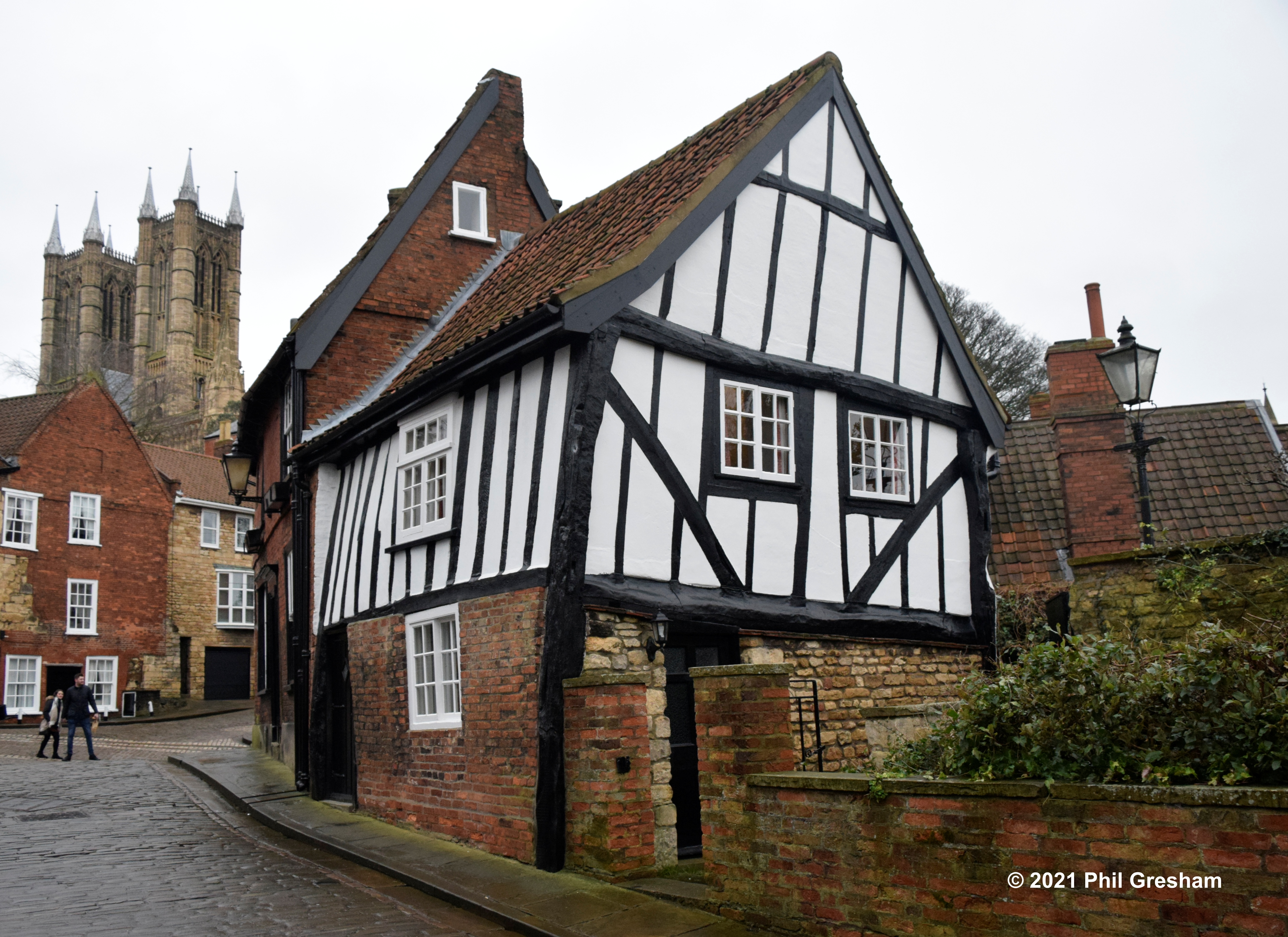
The Crooked House at the top of Michaelgate is well known, and is probably one of the most photographed buildings in Lincoln after the Cathedral, Castle and Stonebow.


This house looked like any other terraced house until the 1930s. At that time there was a major slum clearance throughout the city; in areas close to the factories and foundries of the Waterside, even Jews Court was in danger of being lost until it was rescued by the Lincolnshire Architectural and Archaeological Society (now The Society for Lincolnshire History and Archaeology).  In late 1933, a demolition order was issued for numbers 34, 36, 38 and 40 Michaelgate. When demolition of number 40 began it was discovered there was a half-timbered building behind the brick façade.  The owner of the house asked the council to rescind the demolition order.  Permission was granted by the Minister of Health subject to it not being used for human habitation.   

Dating from the 16th century, the house has 18th, 19th, and 20th century alterations. Dressed stone and brick, with close studded first floor with rendered nogging. Pantile roof. 2 storeys, 2 bays. Street front has a replica plank door to the left, and to the right, a 2-light sliding sash. Above, to the right, a C20 casement. South gable has a 20th century door to left and a 20th century casement above. Gable framing has curved braces and corner posts. (https://historicengland.org.uk/)

The house was acquired by Lincoln Council and renovated to its original style; it became one of the oldest council houses in England.  The house is still owned by the City of Lincoln Council and managed by the National Trust.

Click here to read about the interior of the house


Dernstall House


Dernstall House dates from the late 15th century, altered in the 17th and 18th centuries and restored in 1969.

The Cardinal's Hat


The Cardinal's Hat building is thought to be named after Cardinal Wolsey and dates from the 15th or 16th century.  Originally the home of the Grantham family, after which the nearby street was named later becoming an inn, it remained so until the early 19th century, when it was known as the Cardinal's Cap.  In 1872 it was the premises of Albert W Hall, grocer & baker, established in 1790.  Over the years it became a furniture store until the St John's Ambulance made it their county headquarters and the building was renovated in 1952.

​After almost 200 years it is now a public house again.


High Bridge


High Bridge on Lincoln’s High Street is the oldest surviving bridge with buildings on, in this country. It marks the spot where the Roman Ermine Street crossed the Witham by way of a ford; a bridge was built in the 2nd century.

The river was much wider than today and High Bridge was thought to be made of five arches; today only one arch remains.

There were many bridges like High Bridge in the middle ages; London Bridge for example, but all the others have long since disappeared; the only other bridges with buildings on them in England are Frome Bridge dating from 1667, and Bath’s Pulteney Bridge of 1773.


The Green Dragon


The Green Dragon is a four-gable half-timbered building dating from the 16th century.  It was probably built for a wealthy Lincoln merchant, and bought by the Common Council of the City of Lincoln from Thomas Grantham in 1569.  By 1624 it was known as the Great Garrettes, it remained as tenements and shops until the 1950s.

There was a major restoration of the building in the late 1950s, and the Green Dragon public house moved here from an adjoining brick-built building on the east side of the present building.


The Treaty of Commerce


The Treaty of Commerce is one of the most central pubs in Lincoln; many other central pubs have closed since the 1970s.  The name is said to have come from an 1860 trade treaty with France.  It was named Treaty of Commerce in 1867.  Owned by Ind Coope from 1911.  The plaster and timber frontage was added in 1926 for Ind Coope.

Became O'Donoghues Irish Bar in the 1990s, renamed Honest Lawyer from October 2000 to November 2001.  Reverted to The Treaty of Commerce in November 2001, when it was acquired by Bateman's Brewery


Whitefriars House

By Alfred Ernest White c1880 - Art UK,
Public Domain, https://commons.wikimedia.org/w/index.php?curid=45247605

Sadly only one wall now exists of Whitefriars House, but it has been protected from the elements by the building on the opposite side of Akrill's Passage.

It was called Whitefriars because it was once thought to be part of the Whitefriars Priory; but during the re-development of the Midland Station the remains of the priory was discovered.

By Richard Croft, CC BY-SA 2.0,
https://commons.wikimedia.org/w/index.php?curid=13622278

The original building dates from the 15th century and it has suggested that it could be the former vicarage of St Mary le Wigford.  It was restored in the late 20th century and a shop front added.

It is difficult to get a good photograph of the building so I have used a photograph from when the neighbouring building was rebuilt.


Atton Place


Atton Place on Eastgate is one of the oldest houses in Lincoln.  First mentioned in the accounts of the Dean and Chapter in 1441, it was originally a single storey building.  The building was included in a Parliamentary survey of 1649.

Reputedly named after Canon John de Aton (or Acton), Prebendary of Welton Ryval from 1329-1351. who lived here 1324-1326.

The building was re-fronted in a typical Georgian style in the late 18th century, an extra floor was added in the late 19th century, the house was made up of the properties visible in the image, but divided into two properties about the same time.

The building remained a priests' house for many years.  

It later became the County Assembly Rooms and a ladies boarding school, the large ground floor room was cleared for balls and other functions, the room was 40 ft long by 20 ft wide, entered through the central doorway at the front. The County Assembly Rooms moved in 1744 when the new building opened in Bailgate.  The school closed sometime later and then became the Judges Lodgings until 1810.  

For most of the next 100 years the house became a private house, Since the second decade of the 20th century, it has been home to a group of surgeons, an architect and interior designer, and now an estate agent.

People who lived and worked here 
In 1840 it was the home of 31-year-old Harriet Bainbridge's Boarding and Day Academy, her father Thomas' Academy was situated at 1 Michaelgate, her brother George founded the Bainbridges department store in Lincoln High Street.  Harriet married Richard Waddington, an Ironmonger, in early 1841 and later moved to 3 Guildhall Street.  Harriet died in April 1885.

In 1851 Henry Moss, Town councillor silk mercer & master employing 17 hands, lived here with his wife Louisa, 5 children, nephew, 10 employees and 3 servants.  

1857 Miss Thomas - Preparatory school for young gentlemen, formerly at 31 The Park

1932 Douglas Darbyshire, surgeon


Grand House Built on the Sale of Drugs


Francis Jonathan Clarke was a successful Lincoln High Street chemist, to demonstrate his success he commissioned his brother-in-law, Albert Vickers, to design a house to rival Sibthorp’s Canwick Hall, the result: Bracebridge Hall.


The Hall was completed in 1883 in “A brash and chunky High Victorian" (Pevsner)  style.  A Gothic design, the heavy porch faces west onto Newark Road, standing in extensive grounds, stretching from just south of the Gatehouse public house to All Saints Church and bounded by the railway in the east. 

The area around the Hall was wooded with a fish pond of almost half an acre to the south of the Hall, the rest of the grounds, amounting to about 18 acres, was laid out as parkland. The decorated lodge was completed in 1884. 

Lincoln was a major centre of agricultural engineering and heavily polluted with smoke and smells from the many factory and house chimneys in the city. At this time Bracebridge was still a village but within easy reach of Lincoln city centre by the new horse tram service which terminated in the village.

Francis Clarke died in 1888 at the age of 46 after developing serious lung and heart problems.  George Bainbridge the draper was living there in 1894.  In 1918 it became Bracebridge Hall Club (see below) for employees of W Foster & Co and in the 1930s and 1940s it was part ​of Bracebridge Heath (Mental) Hospital.

​Later it became the offices of Gothic Electrical and it is now Grosvenor Hall Care Home.

Between the wars Bracebridge Hall's extensive grounds were reduced for the building of housing on Brant Road and the “Tree Streets” behind the Hall. Recently the grounds have been further reduced until it stands on land hardly bigger than its footprint. 


Bracebridge Hall Club


The Engineer 1918 March 8th


Other Lincoln Houses