Search This Blog

Lincoln Companies - R M Wright & Co Ltd

 William Dyke was the licensee of the George and Fox in Penkridge in Staffordshire 1869 to 1880, he then became a beerseller, his assets were liquidated in December 1881.  By 1891 he was living in Orchard Street, Lincoln and employed a corn merchants labourer, probably for Henry Elsey who was a lodger in his home.

William and his wife had two of their children living with them in 1891.  Their oldest child, Albert George Dyke, worked as a confectioner. 


Albert was a successful racing cyclist, gaining many cups, statuettes, vases, shields during his racing career.  He began racing in 1880 when he lived in Staffordshire.  Albert was asked by a Lincolnshire Echo reporter why he was not racing under his own name, his response "... when I started racing I raced under my own name I was then 16 and was apprenticed at Wolverhampton.  In 1881, I had a bad smash, and my employer then said he would not allow me to race, but I thought I could do something, so I decided I would try.  I wrote to the NCU* and the AAA*, stating my case, and asking that I be allowed to ride in a family name R M Wright.  I was granted permission, but with the condition that I never ride in any other name so long as I live."  He rode under his brother in laws name
Ralph Montague Wright.

Albert started his business by selling Sunbeam bicycles from his home in Orchard Street in 1892


He married local woman Rose Emma Horner in 1894. Between 1895 and 1902 they had 3 children, the last was Ralph Montague (R M) Wright Dyke, named obviously with intention of taking over the business later, sadly Ralph died in 1903.

Wrights launched the "Stonebow Autocar" made by Payne and Bates of Coventry in 1900.  R M Wright & Co were the first motor dealers in Lincoln
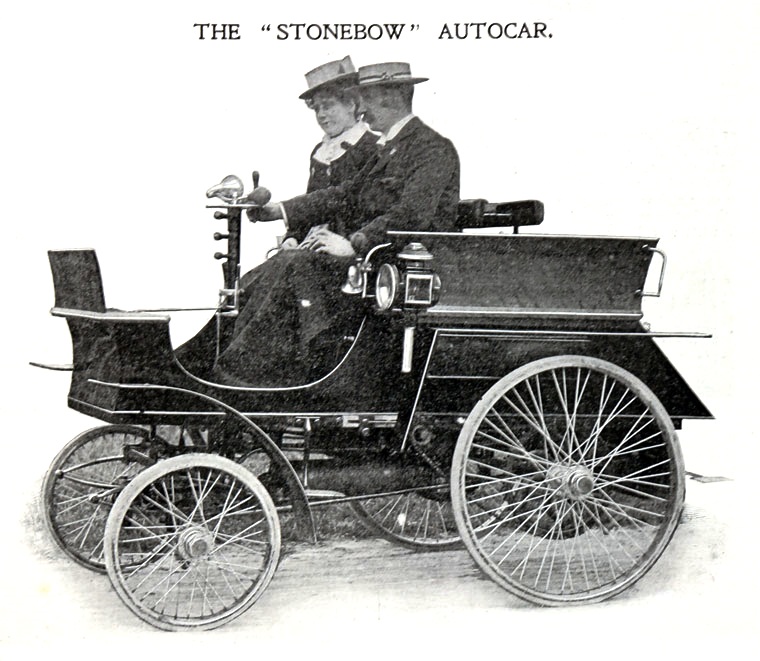
Wrights also sold a range of Stonebow Cycles.

In the 1901 Census Albert and Rose were living at 88 Bailgate, Lincoln,his occupation was shown as ”Cycle & Motor Manufacturers Agent”. By 1911 they were living close to the business at 12 Newland .


He was a keen motorist involved with motoring clubs in Lincoln and Nottingham, this led to the early success of his business; he entered competitions in the name of R M Wright to give publicity to his business. To prove the reliability of the Humber car he organised a 5,000 mile trial. He also took part in other trials.

Albert was what we would today call a "boy racer", convicted many time of riding a bicycle (even in a race) or driving a car "furiously" and driving at excess speed, ranging from 7 to 27 mph.

Their showroom on Newland featured a vehicle lift so that cars could be raised to the first floor showroom.  This showroom would accommodate over 30 cars.


Incorporated as R M Wright & Co Ltd before 1919.

R M Wright became Austin distributors in 1922

Albert’s wife died in Lincoln in1927.

The company was taken over in 1927 and became R M Wright (1927) Ltd., the directors were Frederick Arthur Cox, Margaret A Cox and John Charles Ivens; F A Cox was managing director of the company. Frederick Cox died in November 1938, he had been ill for over 5 years. John Ivens became managing director.  1953 entry from www.gracesguide.co.uk R. M. Wright & Co. (1927) Ltd. Car and Light Commercial Vehicle Stockists. Newland, Lincoln. Telephone: 397. Directors: J. C. Ivens (Managing). M. A. Cox. F. R. Cox. Peter J. C. Ivens (Sales Manager). Managers: S. Pinder (Service—Repairs). F. H. Kirby (Spares).

Albert Dyke died in Oswestry in 1940

R M Wright (1986) Ltd was acquired by the Lincolnshire Co-operative Society Limited in1986

Wrights remained as distributors for Austin motor vehicles, continuing through British Motor Corporation, the nationalised British Leyland Motor Holdings, British Leyland and the Rover Group.  Unfortunately, financial health of the company was closely linked to that of its supplier.  It was obvious to the owners of the company that the Rover Group was in trouble so it was decided that R M Wright, after nearly 100 years of trading, would be wound up and the Lincoln premises on Outer Circle Road would be re-branded as Holland Bros and the more appealing Jaguar products would be retailed.

In early 2012 Lincolnshire Co-operative Ltd sold Holland Bros to the Marshall Motor Group.  


*National Cyclists Union

*Amateur Athletics Association

Lincoln Companies - W I Binks

For many Lincoln people aged over 50, W I Binks was the main cycle dealer in Lincoln.

St Benedict's Square 1894 to 1961


William Irwin Binks was born in Lincoln in 1870. He trained as a cadet in the merchant navy

About 1886 travelled to the United states to work for his uncle, Giles Ambrose Binks

Returned to England about 1891 and became a successful racing cyclist. He was elected the first secretary of the Lincoln Road Club, winning the first 50 mile race.

It was announced in the Lincolnshire Echo of 23 January 1894 that W I Binks was taking over the management of R M Wright's Water Lane cycle depot, R M Wright negotiated with a cycle manufacturer to rebrand their cycles 'Stonebow'.

William Married Rosetta Serth at Bethnal Green in about February 1894.

Binks opened his own cycle business 5 and 11 St Benedicts Square in 1894. In December 1894 Binks advertised they were selling bicycles with the names "Humber-Synyer", "Rothwell", "Quinton Scorcher" and "Endurance" at their depot at 111 High Street opposite St Mary's Guildhall.

1895 Advert

In July 1895 Binks bought the former premises of Drury, Newbold and Hill at Wellington Works, 11 St Benedict's Square.


Harlock Middleton Drury moved to premises on High Bridge, in 1906 he was adjudged bankrupt. Drury lived on Wellington Street. Bink's continued trading from 111 High Street.


1900 Advert


The acquisition of the Wellington Works allowed Binks manufacture and market the Wellington bicycle, production ended in 1904 when mass produced cycles became available.

1901 Advert


Binks also sold cars and motor cycles


The depot at 111 High Street was closed in September 1895.

November 1896 alteration were being carried to the premises at the Wellington works when gas was smelt on the upper floor. Binks used a match to light the escaping gas but gas had accumulated below the floor and there was an explosion, Mr Binks was burned on his face, hands and arms. Part of the ceiling on the floor below was brought down. A large Renault car and several bicycles were lost in the fire.

May 1900 Binks opened a showroom at 333 High Street (Whitefriars).

J O Serth, William's brother in law, joined the business in 1904, he became a partner in 1905.

William travelled to New York on RMS Carmania, departing 14th June 1913 arriving 1st July 1913

Special constable during World War One

1917 Fell off his bicycle while riding with his youngest son on Station Road Waddington, he was taken to the County Hospital.

Louis Irwin Binks, William's son joined the company in 1919.

William Irwin Binks died from the injuries sustained while cycling in 1917 in 1921

Binks store was moved to the corner of Portland Street in 1961 and finally closing in 1975.

Josiah Serth died in 1972 at the age of 96.

William Edmund Binks died in 1975, maybe the last Binks involved in W I Binks "The Cycle People".


Lincoln Arboretum

The Lincoln Commons Act of 1870 enabled Lincoln Corporation to purchase Monks Leys Common for the building of housing for Lincoln's booming population. Towns and cities throughout the country were recognising the leisure needs of their people, Lincoln was no exception in this and in 1870 undertook to provide a public park in what was to become a densely populated part of the City.  Temple Gardens, although privately owned, had been used as a public park on an informal basis.  Joseph Mawer Collingham, a son of the founder of the department store, Joseph Collingham, bought Temple Gardens in 1863 and built his new house on Lindum Road on the south side of Temple Gardens.  Read more about Temple Gardens here.


Edward Milner (1819-84) was commissioned to design what was to become The Arboretum.  Milner was responsible for the design of the grounds of Hartsholme Hall in 1862.  Three acres of Monks Leys Common was sold to fund the development of The Arboretum.  Milner also designed the West Gate Lodge and the Tea Room at the main entrance from Monks Road.  At the first flight of steps an Edward Milner designed a pavilion was erected but, following years of neglect and vandalism, it was taken down in 1948.


The Arboretum was opened in August 1872. The importance to local people of the new attraction was the fact that 25,000 people attended the opening ceremony (Lincoln's population at the 1871 census was a little less than 27,000).  The people were entertained by Professor Renzo’s Performing Dogs, Mr Emmanuel Jackson, the Midland aeronaut in his new balloon, brass band recitals and a ladies choir from Liverpool.

F J Clarke, a successful Lincoln chemist, in 1872 presented to the Arboretum a Coade stone lion by Austin & Seeley of New Road, Regent's Park.

The Arboretum Lion
Dave Hitchborne / The Lion, The Arboretum, Lincoln / 

Brass Band concerts* had become a popular event in the Arboretum and in 1884 a bandstand was erected on the large lawn in front of the terrace and a cast iron shelter constructed by Lockerbie and Wilson, of Tipton, Staffordshire, was also erected about the same time.


In 1894 Nathaniel Clayton Cockburn donated land to the north west for an extension to the Arboretum.  This was laid out by Edward Milner's son Henry Ernest Milner (1845-1906).


A fountain was erected in 1911 to celebrate the turning on of
the new water supply from Elkesley in Nottinghamshire.

Sister Swan's Nursing Home at Cold Bath House, stood near the Junction of Lindum Terrace and Sewell Road.  During the Second World War the House was bombed and eventually demolished. The house got it's name from a spring which ran into its cellar.  In 1953, to celebrate the Coronation of Queen Elizabeth II, the site was landscaped and added to the Arboretum, the spring is used to create a water feature in the Arboretum.  This extension increased the area of the Arboretum to 21 acres (8.8 hectares).

The Arboretum was renovated in 2002/3 at a cost of £3 million to bring it back to its original condition.

*In 1889 over 40,000 people attended the band concerts.

 Over 100 more posts @  https://itsaboutlincoln.blogspot.com/p/index-to-blogposts.html


Lincoln Companies - Fambrini & Daniels

 This unusual building stands on Canwick Road.

Joseph Fambrini, born in Italy in 1815, was a plaster manufacturer and landlord at the Packet Inn on Waterside North.  He later moved to the Crown & Cushion (The Pelham Bridge in the image below) on Melville Street.


Fambrini produced artificial stone and moulded it to customer requirements.  Fambrini and Joseph Daniels, his grandson, became partners in Fambrini & Daniels.  They produced decorative artificial stone mouldings, they were listed in street directories as artificial stone manufacturers and architectural modellers.

Fambrini produced artificial stone and moulded it to customer requirements.  Fambrini and Joseph Daniels, his grandson, became partners in Fambrini & Daniels.  They produced decorative artificial stone mouldings, they were listed in street directories as artificial stone manufacturers and architectural modellers.

Florence Villa later Villa Firenze


Fambrini no doubt benefited from the rapid growth of Lincoln housing in the latter half of the 19th century as he had a large house built on the corner of  Monks Road and Baggholme Road in 1876, naturally artificial stone was used to decorate it. It was named Florence Villa (Florence may be where he was born).  Fambrini resigned from the partnership in 1889 and Daniels continued trading as Fambrini & Daniels.  Fabrini died in 1890 and his house was renamed Villa Firenze.

In 1899 Joseph Daniels commissioned William Mortimer to design an office & showroom (top picture) for Fambrini & Daniels.  It was designed to exhibit many of the companies products.  The building is Grade II listed.  The eaves cornice has decorative corbels and banding, with above in parapet a projecting panel decorated with pendant flag and wreath. Rainwater heads in
form of monstrous heads. Side entrance facade has similar elaborate architectural detail. Topped with panel bearing Lincoln City coat of arms surmounted by segmental pediment
bearing date 1889.


The business was taken over by Lindum Stone Company about 1913.

Over 100 more posts @  https://itsaboutlincoln.blogspot.com/p/index-to-blogposts.html

Lincoln's Gates


Lincoln's Gates

In the medieval age Lincoln had more gates than many other towns or cities of a similar size.
Newport Arch (Porta Principalis Sinistra)
Newport Arch by Skill

Newport Arch was the north gate of the upper Roman town of Lindum Colonia. It is now the only Roman arch in the country still open to traffic. It is the northern entrance to Lincoln’s historic centre that includes most of Roman and Medieval Lincoln.

Built in the 3rd century, Ermine Street passed through it to link Lincoln to another major Roman provincial centre, York. The arch was enlarged when the city became capital of the province Flavie Caesariensis in the 4th century. The remains we see today are of the inner arch and a footway on the east side of the arch, the outer arch was demolished in the late 18th century. The arch was much higher in Roman times, approximately 2.4 metres of it are below today’s ground level. More about the design of the gateway was discovered in 1954 when the north-west bastion, a semi-circular structure, was excavated, the remains of which are still visible. There would have been another bastion on the north-east side of the gateway, the remains of that are now below the adjoining cottage.

Drawing of Newport Arch dated 1784.  The north gate can be seen
through the arch.  On the right is a sign for the Windmill Inn which
dated from 1756


The East Gate

Drawing of the Roman and medieval east gate by Nathan Drake c 1740

The Roman east gate (Porta Praetoria) was re-discovered in about 1730, it had been used as a wall wall between a house and stables. Sadly, it was demolished in 1763 on the orders of Sir Cecil Wray when Eastgate House was extended.

The remains of the Roman East Gate are visible in the grounds of the Lincoln Hotel opposite the north side of the Cathedral Chapter House.

The West Gate

Roman West Gate uncovered, to the right can be seen
the Norman west gate which was reopened in 1993.


The Roman West Gate of the upper city lies below the west wall of the castle. It was discovered in 1836 when the west side of the Castle Dykings were excavated. It was in almost perfect condition but had to be covered up because the weight of the Norman castle wall was causing it to collapse.


The Exchequer Gate

Exchequer Gate by Benjamin Howlett 1836


The Exchequer Gate, at the west front of the Cathedral, was the main entrance to the Cathedral Close. Built mid 14th century. It was originally a double gate with a courtyard between the gates. The western gate had fallen into disrepair and was pulled down in 1800, the stones were used to build the previous St Swithin's Church, a replacement for the church destroyed by the Royalists during the Civil War, ​ The Great Tom Inn was on the southside of the courtyard, the inn closed in 1822.


The South Gate

A Drawing of the Roman South Gate
by Nathan Drake c 1740


The Roman South Gate (Porta Principalis Dextra) stood near the top of Steep Hill. Parts of this gate were still standing in 1788 when Gough visited the city, but the arch was demolished in the early 1700s by a householder on the east side of the gate. According to Thomas Sympson writing in the early 18th century: (the arch was knocked down) "though not without much difficulty, as I have been informed by an eye-witness; for when the workmen, with a great deal of labour and pains, had battered one of the stones in the crown of the arch in pieces, rest being laid without mortar, sunk so equally on both sides that the hung as firm as ever, and their work was to begin anew". The position of the gate is marked by foundation stones on the side of the road

The Old Registry or North Gate of the Close


This double gate stood over the road on the east side of the Cathedral, the south gate on the site of the present Priory Gate the north gate near "The Rest".

​Both gates were pulled down in 1815 and the present Priory Gate was built in 1825.

The Bail Gate
On Steep Hill, near the junction with Michaelgate/Wordsworth Street/Christ's Hospital
Terrace stood the Bail Gate, a medieval arch that was demolished in 1775. Separated the Bail
from the city.  I can not find an image of the gate but it was probably similar to the Newland Gate

White Hart Gate


"A gateway near the White Hart Inn, and another opposite are of a workmanship very different from the rest of the erections on the wall of the Close: they possess little beauty and afford still less interest to the beholder. The appearance of that nearest the White Hart, is little superior to that of a country barn; is entirely without battlements, and the upper part projects considerable over the lower, and is supported by props resembling inverted buttresses." - Adam Stark (1815).

Clax le Gate


Clax le Gate or Clask Gate was situated at the junction of what is now Broadgate and Clasketgate. It is said the Knights Templars were confined there click here to read more. It was pulled down in 1785 when New (Later Lindum) Road was constructed.

Stonebow


The name Stonebow is from the Norse Steinbue meaning stone arch
Many streets that run nearby end in -gate which is Norse for street.

The Stonebow lies at the southern end of the Roman city of Lindum Colonia and stands on the site of the southern gate of the lower Roman town spanning Lincoln’s High Street, known as Ermine Street in Roman times. The Roman gateway existed into the mediaeval period but it was demolished in the 14th Century because it was unsafe.

In 1390 Richard II ordered a new gate be built to replace the demolished one. There were many delays in building the new arch, mainly that Lincoln was no longer the prosperous city it once was and could not afford the expense of a new gateway. The Stonebow, was eventually completed by William Spencer, a freeman of the city, in 1520 and is now a Grade 1 listed building. 

Newland Gate


Newland Gate stood on Newland a little west of Wigford Way, first recorded in 1275. It was the
west entrance of the lower city. A tall building with gables with a pointed archway, above were
arched windows. The gate was added to during the Civil War to defend the city against the
Parliamentarians. Demolished before 1800 because it was causing congestion in that part
of the city.  

Dernstall Lock
Dernstall Lock (sometimes mistakenly referred to as "St Dunstan's Lock") was the lower entrance to the Jews' quarter in mediaeval times. It is not known whether there was a gate, a chain was placed over the road and locked to keep the Jews in there at night.  

Great Bargate
Great Bargate stood on the High Street a few feet north of the Sincil Drain. It was the main
entrance from the south into Lincoln. Removed in the middle of the 18th century.  

Little Bar Gate
Little Bargate stood east of Great Bar Gate on a bend in the Sincil Drain, it stood over the
route of the Roman Ermine Street.  The gate was removed in the middle of the 18th century
and the bridge removed in 1825. 

​Swine's Gate
Swine's Gate was located south of Great Bar Gate. Here stood the first of the Eleanor Crosses.