Search This Blog

Lincoln's Royal Bishop

Geoffrey Plantagenet was an illegitimate son of Henry II.  He was born about 1150, before his father married Eleanor of Aquitaine.

Even though he had not taken holy orders he was appointed Archdeacon in 1171, in 1173 he was elected Bishop of Lincoln and his position was confirmed in 1175.

Bishops of the middle ages were often involved in military battles, Geoffrey was no exception, in 1173 and 1174 he led a campaign to put down a rebellion by his legitimate half-brothers in the north of England.  The King's sons we unhappy about the gifting of three castles, in the inheritance of Henry the "Young King", to John, his youngest son, as part of a marriage settlement.  The rebellion which covered an area from southern Scotland to northern France was put down. Henry and his sons were reconciled.  Henry II ordered 10 castles demolished after the rebellion.

Geoffrey was not remarkable in any religious way but he did clear off the bishop's mortgage and add two bells to the Cathedral.  Geoffrey resigned in 1182 to become Archbishop of York and was ordained in 1191 in Tours, France.

He was the only one of Henry II's sons attending when his father died in 1189.

As Archbishop of York he was in constant dispute with his clergy and the king and, following a dispute with King John in 1207 about taxes, he fled to France where he died in 1212.


Lincoln's Traffic Problems: A Missed Opportunity?


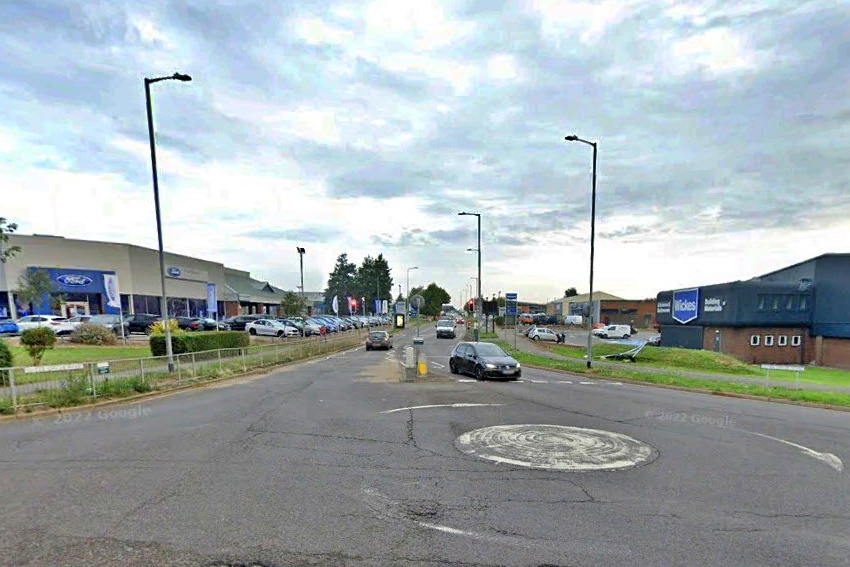
Image from Google Earth

Have you ever thought what the name Outer Circle Road means?  .

In October 1917, towards the end of the First World War, the city council discussed the possibility of building a road from Greetwell Road to Wragby Road.  The war over, in December 1920 the Ministry of Transport agreed to contribute half the estimated cost of £14,210. Like many other projects in this country at that time it was seen as way to give work to the vast numbers of unemployed.  The road was completed in 1922

James Hole & Company Ltd of Newark applied in February 1924 to the Licening Justices for a licence for serving intoxication liquor at proposed premises at the junction of Wragby Road and Outer Circle Road - The Bowling Green Hotel.  The Bowling Green opened in July 1926, Ronnie Sewell, former professional footballer for Burnley and Blackburn Rovers, was the first landlord.

With the building of the St Giles' Estate, a new road was built from Wragby Road opposite Outer Circle Road and called Outer Circle Drive; possibly the powers that be decided "Drive" would be more attractive to the people who were being moved from properties in Stamp End and other parts of the city.

Owners and tenants of 208 to 218 Doddington Road were summonsed to court for "failing to abate a nuisance in regard to drainage", the magistrates were not prepared to make an order, they felt it was the corporations responsibility.  Robert Horton, the owner of 216 & 218, produced a plan provided by the corporation in 1929, when the houses were built, the letter accopanying the plan referred to a proposed "Outer Circle Road"; it seems the intention was to continue the road around the north and west of Lincoln and joining with Newark Road at Swanholme.

There were many complaints about the state of footpaths on St Giles, Outer Circle Drive was often covered by mud, it seems the Corporation didn't have the money to complete Outer Circle Road.


Beaumont Fee

In the Middle Ages Lincoln was divided into three districts: the City, the Close, and the Bail.  The Close and the Bail were self-governing, outside the City's jurisdiction.  These areas were managed through local courts. The freemen made the laws and carried them out, the system was democratic as every freeman was expected to involve himself in the running of a district.

There was another district in Lincoln outside the jurisdiction of the City authorities during the middle ages. Prior to the Norman conquest there were a number of former Danelaw divisions of Lincoln that were ruled by the most powerful citizens.  One of these divisions survived the conquest as a self-governing unit, the manor of Hungate.

Edward II granted Hungate to Henry de Beaumont.  A manor house was built on the west side of the road now known as Beaumont Fee and to the south of West Parade.  The house was known as Vesci Hall (Henry's sister, Isabella de Vesci, was granted the manor before Henry, she held it from about 1312 to 1335), the manor became known as "The Liberty of Beaumont Fee", and was the centre of the control of the Beaumont lands in the east of England.  The definition of "fee" in this context is: an inherited or heritable estate in land

The Liberty of Beaumont Fee was held by the Beaumonts for about 200 years, but their lands were confiscated after the Wars of the Roses.  In 1514 these lands were granted to Lord Howard, son of the Duke of Norfolk, for his support at the Battle of Flodden.  The manor was sold by the Norfolk family in 1700.  It was then broken up between different owners and lost its privileges.

Vesci Hall appears to have survived until the 1840s when John Hayward, a chemist, built  Beaumont Manor in the Tudor Revival style. Lincoln Corporation bought it in 1927. 

Beaumont Manor
Beaumont Manor


5 to 15 Beaumont Fee

These fine townhouses on Beaumont Fee, built in 1885, were designed by William Watkins for Charles Knowles Tomlinson (1819-1893).

Charles was a chemist in partnership with Charles Hayward (1836-1880), his brother-in-law at 233 High Street and 6 Bailgate.  Henry Hyett managed the shop in the Bail and took over the business after Charles Hayward's death.  Frederick P Watson who succeeded Henry Hyett at 6 Bailgate lived at 5 Beaumont Fee, the house on the far right of the picture.

Charles Tomlinson was born at Toulston Hall in North Yorkshire and lived across the road at Beaumont Manor.

Tomlinson and Hayward filed a patent in 1865 for a sheep ointment preparation, it is not known how successful it was.

The houses are now offices for various businesses including solicitors and archaeologists.

St Benedict and Old Kate

St Benedict's Church in 1905

A Saxon church existed on the site of St Benedict's church at the time of the Norman conquest, although most of what we see today is of the 13th and 14th centuries. The church was once much grander and larger, a victim of the Civil War, the chancel and north aisle is all that remains, the church was repaired and the tower was reconstructed against the west side of the medieval chancel arch after the Restoration, in a position to the east of the original tower.

Prior to the Civil War St Benedict's was the Lincoln Civic church. Many of Lincoln's churches were damaged or destroyed during the Civil War, only three churches were able to conduct public worship: St Peter at Arches, St Mary le Wigford and St Peter at Gowts.

The exterior gives little hint to the grandeur of the church prior to its partial demolition, at one time it was the church of the richest and most important people of the city; many affluent citizens of the parish have monuments within the church. It was rebuilt at a time when Lincoln was in decline and no longer had the benefit of the Wool Staple.

The parishioners of St Benedict's were transferred to the nearby St Peter at Arches church when St Benedict's church was retired as a parish church.

Old Kate
In 1585 the Company of Barber Surgeons gifted a curfew bell to the church, hung in the bell tower, it was rung at 6 a.m. to tell workmen it was time to go to their work and 7 p.m. to tell them to finish their days toil and later in the evening to extinguish their lamps and candles. The bell was known as "Old Kate". It was rung for many years by John Middlebrook, the parish clerk; he lived in a lean-to building attached to the north side of the tower. He died in December 1804 and his wife, Mary, succeeded him as parish clerk and took on the job of ringing Old Kate. It is said she brought the bell rope through belfry door and into her bedroom so that she could ring the bell when in bed. Mary died 7th November 1822 at age 72, old men and boys continued to ring the bell kneeling on her bed. The Corporation paid 6s 8d (33p) a year until 1837. The bell was later hung in the tower of St Marks, I understand it was returned to St Benedict's church in 1971, when St Mark's church was demolished

Potential Demolition
The church was closed in 1931 and demolition was proposed. However, following a public outcry, the church was saved as the result of an appeal led by the Lincoln Architectural and Archaeological Society and renovation work was undertaken. Sadly, the LAAS were not so forthcoming when the much grander St Peter at Arches church was demolished.

St Benedict's Church by Samuel Hieronymous Grimm, 1784

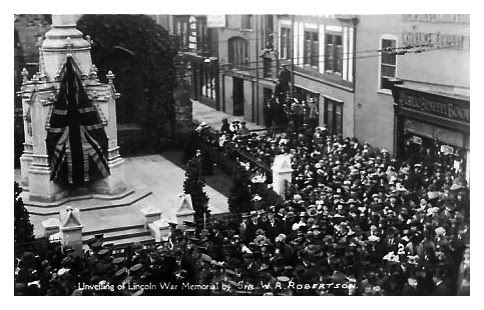
War Memorial

War memorial. 1922. By Montague Hall. Ashlar. Gothic Revival style. Moulded plinth with quatrefoil band. Octagonal base 
with crocketed gabled diagonal buttresses, with the faces inscribed with names. Panelled octagonal shaft with moulded stepped base, topped with a gabled tabernacle and crucifix.
(Buildings of England : Lincolnshire: Pevsner N: Lincolnshire: London: 1989-: 524).

The Foundation stone was laid by John Harris, J.P.  Dedicated by the Bishop of Lincoln, Edward Hicks, and unveiled by Field Marshal Sir William R Robertson Bart GCB GCMG KCVO DSO on  25th October 1922


The Lost Houses of Lincoln - Eastcliffe House

Eastcliffe House was designed by Henry Clutton for Nathaniel Clayton of Clayton & Shuttleworth. The house was built between Sewell Road and Lindum Terrace in 1877.  A grotto was constructed in the 1870s in the grounds of the house, Pulhamite mortar was used to make garden features including paths, flights of steps and a bridge over a pond.  The grotto is now in the grounds of 12 Lindum Terrace, the bridge has not survived.

Nathaniel ​Clayton died in 1890 at the age of 78, his wife had died three years earlier.

The house was offered for sale for a number of years and eventually became residence of Henry Elsey.

The house was auctioned by Henry Elsey in 1920, not sure if it sold, it was demolished in 1926. Many large houses were demolished it the 1920s and 1930s, there was a shortage of raw materials and the stone, wood, etc of the houses was worth more than the complete buildings see https://itsaboutlincoln.blogspot.com/2017/01/sad-end-to-grand-country-house.html. Another reason was the shortage of domestic staff, women had got their "freedom" during World War One.

The Accident-Prone Steam Locomotive

British Railways locomotive 60123 "H A Ivatt" was built at Doncaster in February 1949. On the 25th October the engine was pulling a fast goods train from King's Cross to Doncaster. However, it was diverted along the Lincoln Avoiding Line due to a broken rail at Claypole. The express goods collided with some empty goods wagons travelling in the same direction at the Skewbridge end of Coulson Road. The A1 Pacific locomotive fell down the south side of the 30 foot high embankment taking a blazing brake van with it. Four railwaymen were injured and were treated by residents of Coulson Road while waiting for ambulances.

The scene on the Lincoln Avoiding Line

60123 was repaired and continued to work until 1962.

On 7th September 1962 60123 again on express freight duties, leaving King's Cross at 8:50 p.m. for Leeds, at Offord near Huntingdon collided with the rear of the 8.25 p.m. King's Cross to Gateshead express freight which was stopped at signals. Fifty wagons and a steam locomotive, blocking the southbound track, were derailed. Four of the six crew on the two trains were injured and taken to Huntingdon County Hospital.

60123 at Doncaster following collision at Offord.


60123 was scrapped at the Doncaster Works in October 1962. The rest of the class, numbered 60114 to 60162, was scrapped between 1962 and 1966, a total of 49 engines, none were preserved. In 2008 a completely brand-new engine of the same class was completed, 60163 Tornado.

Henry Alfred Ivatt (16 September 1851, Wentworth, Cambridgeshire – 25 October 1923) was an English railway engineer, and was the Chief Mechanical Engineer of the Great Northern Railway from 1896 to 1911.  -- Wikipedia  


Don't Wear Your Crown in Lincoln

St Mary le Wigford church stands next to the railway line on St Mary's Street in today's centre of Lincoln. Built during the 11th century by Eirtig.  It was one of the 15 Lincoln churches that survived the Reformation: there were 52 churches until this time but many of the parishes they served were deserted or were very small.  Parishes were combined and many of the redundant churches were pulled down.


Since the time of King Stephen Lincoln had been seen by the English kings as an important city. Several kings, including Henry II, spent Christmas at Lincoln.  The parish of Wigford, being outside of the walls of the city, was a suburb of Lincoln during the medieval period.

The memorial stone in the church tower of St Mary le Wigford is well recorded, you can read more about it here, but I write about an interesting event that took place in the 12th century:

Henry II's coronation was in London on 19 December 1154, John Speed, the chronicler, says he was crowned at Lincoln in 1155, while Paul de Rapin-Thoyras, the French historian, describes the event as having taken place at Wickford (Wigford) in 1158.  The date given by Speed is more likely to be correct as Henry probably used his second crowning as a way of securing the support of his subjects prior to his departure for Flanders, where he was guardian of the lands of Dietrich of Alsace (Deitrich asked Henry to guard his lands while he went on a crusade to the Holy Land).

The chronicler, Roger of Hoveden,(?-1201) stated that the King cautiously avoided entering the walls of Lincoln, for the ceremony, but wore his crown in Wigford, due to a widely believed prediction, that no king wearing his crown in Lincoln would have a prosperous reign.  

The Battle of Lincoln

Henry I's Barons swore an oath to support Henry's daughter Matilda as Queen of England.  Henry I died in 1135 and the Barons broke the oath favouring Stephen of Blois, Matilda's cousin, as King.  In 1139 Matilda, with the assistance of her half brother, Robert of Gloucester, seized control of Bristol and much of the West Country.  Civil war broke out throughout England, one of the most important battle was that of strategically important Lincoln.

The lead up to the battle of Lincoln began in the year 1140 when Ranulf of Gernons the earl of Chester, and his half brother William of Roumare joined the rebellion against Stephen and captured Lincoln Castle.  

Drawing of the Battle of Lincoln from Henry of Huntingdon's Historia Anglorum

The capture of the castle was achieved through a simple stratagem; they both sent their wives on a friendly visit to the castle, so that when Ranulf appeared with three escorts ostensibly to escort the women home he was readily admitted. Once inside however, Ranulf and his men overpowered the guards, seized control of the gatehouse and admitted William with a small force of knights to seize control of both the castle and the city of Lincoln itself.

Stephen was understandably not pleased, and after Christmas he assembled an army and marched on Lincoln.

Stephen laid seige to Lincoln castle but were themselves attacked by a relief force loyal to Empress Matilda and commanded by Robert, Earl of Gloucester,  Matilda's half-brother.

The battle was fought on the 2nd February 1141 between Stephen, King of England, and the earls Ranulf and Robert, supporters of Matilda.

Ranulf made contact with Robert of Gloucester and also managed to raise a significant contribution from Wales.

Meanwhile Stephen busied himself with the construction of siege engines and made plans to retake the castle, whilst the earls of Chester and Gloucester combined forces and marched on Lincoln to raise the siege.

The site of the battle was between the castle and the West Common.

Stephen soon became aware that he was threatened by a large force, but declined the advice of those that urged him to either flee or seek a truce, and decided to stay and fight. Robert's army consisted of the divisions of his men, those of Ranulf, Earl of Chester  and those disinherited by Stephen, while on the flank was a mass of Welsh troops led by Madog ap Maredudd, Lord of Powys, and Cadwaladr ap Gruffydd. Cadwaladr was the brother of Owain, Prince of Gwynedd, but Owain did not support any side in The Anarchy. Stephen’s force included William of Ypres; Simon of Senlis; Gilbert of Hertford; William of Aumale, Alan of Richmond and Hugh Bigod, but was short of cavalry.

The core of Stephen's force was composed of some Breton and Flemish mercenaries, under the command of William of Ypres and Alan of Dinan respectively, and Stephen may well have believed that with such professional troops on his side he had little to fear. 

Stephen sent some of his troops forward to attempt to prevent the opposing army from crossing a nearby ford, but the opposition charged his lines, seized the ford and proceeded to engage the main body of his army. It soon became clear that Stephen was in danger of losing. The two earls therefore seemed to have had the advantage of numbers and they rapidly made it tell.
Seeing the tide of battle favouring the other side both William of Ypres and Alan of Dinan made their excuses and left. Once they'd gone a number of other Norman and English knights abandoned Stephen as well.  Stephen surrendered to Robert of Gloucester, who naturally handed over this valuable prize to his half sister Matilda.

When the citizens of Lincoln heard of the king's defeat, many of them abandoned their homes and fled towards the nearby river and sought to escape by boat across the water, but many were drowned when the boats capsized in the general panic to escape. 

Stephen was taken prisoner and taken to Gloucester before being imprisoned in Bristol Castle. With Stephen now out of action Matilda could (and did) consider herself Queen of England. She travelled to Winchester where the assembled clergy hailed her as the Lady of the English before proceeding to London where she began arrangements for her coronation. Unfortunately for Matilda her general arrogance and petulant demands for money soon angered the citizens of London sufficiently that they rose up against her and drove her out. Furthermore, Stephen's wife raised an army herself, and managed to defeat and capture Robert of Gloucester at the battle of Winchester. Matilda was forced to release Stephen in exchange for her brother Robert. 

An Account of the Battle
"Then might you have seen a dreadful aspect of battle, on every quarter around the king's troop fire flashing from the meeting of swords and helmets - a dreadful crash, a terrific clamour - at which the hills re-echoed, the city walls resounded. With horses spurred on, they charged the king's troop, slew some, wounded others, and dragging some away, made them prisoners. No rest, no breathing time was granted them, except in the quarter where stood that most valiant king, as the foe dreaded the incomparable force of his blows. The earl of Chester, on perceiving this, envying the king his glory, rushed upon him with all the weight of his armed men. Then was seen the might of the king, equal to a thunderbolt, slaying some with his immense battle-axe, and striking others down. Then arose the shouts afresh, all rushing against him and him against all. At length through the number of the blows, the king's battle-axe was broken asunder. Instantly, with his right hand, drawing his sword, well worthy of a king, he marvellously waged the combat, until the sword as well was broken asunder. On seeing this William Kahamnes, a most powerful knight, rushed upon the king, and seizing him by the helmet, cried with a loud voice, 'Hither, all of you come hither! I have taken the king!'"
— Roger de Hoveden, writing in the late 12th century

The Anarchy
The Anarchy was a civil war in England and Normandy between 1135 and 1153, characterised by a breakdown in law and order. The conflict originated with a succession crisis towards the end of the reign of Henry I, when the king's only legitimate son, William Adelin, died aboard the White Ship. Henry's attempts to install his daughter, the Empress Matilda, as his successor were unsuccessful and on Henry's death in 1135, his nephew Stephen of Blois took power with the help of his brother, Henry of Winchester.
The 150 Year Old Chemist Shop

Bailgate is one of the oldest streets in Lincoln, much of it approximately follows the north to south line of Roman Lindum Colonia's main street.  Some of the buildings date from the 17th century, there is one shop in the street that still has its 19th century owner's name emblazoned above the window: F P Watson


Frederick Percy Watson was born in 1865 in Lincoln, his father also Frederick, was an engineers clerk..  He learned his trade at Allen & Hanbury in London, a manufacturing chemist.  Allen & Hanbury were owned by a Quaker family so it is possible that Frederick's family were Quakers, particularly as Frederick's family lived in Beaumont Fee a short distance from the Quaker Meeting House.

F P Watson Bailgate
1894 Advert
Frederick married Edith Brackenbury in 1895 and they had 3 children.  Her father Elijah was a chemist in Bardney near Lincoln.

Henry Hyett was manager of the shop when it was owned by Charles Knowles Tomlinson and Charles John Hayward, he took over the shop in 1880 following the death of Hayward.

Frederick acquired the business at 6 Bailgate from Henry Hyett in the early 1890s, renaming it "F P Watson", the shop still bears his name 100 years after his death. 

Frederick died in 1922 at the age of 57, an early death was not uncommon for chemists at time due to their handling of poisons used in various "miracle" remedies.

Charles Knowles Tomlinson built Frederick's parents' house on Beaumont Fee, based on a design by William Watkins.


The Lincolnshire Pub the RAF Destroyed

The Sir Isaac Newton in the 1930s, possibly shortly before demolition

Heading north on the A46 from Newark it is almost impossible to believe there once was a public house a short distance south of the roundabout at Halfway Houses.

The pub began life at Halfway House Farm.  In 1856 the pub moved south to its final location.  It and the nearby Red Lion were well placed to serve and accommodate the weary traveller being almost exactly midway between Newark and Lincoln.

During the Lincoln Handicap it was usually granted an alcohol licence extension so the late night travelling punters could celebrate their wins and losers could get some consolation in an alcoholic drink.

Auctions and inquests were also held at the pub.

Its end came with the building of RAF Swinderby, one of the last stations completed under the RAF's expansion plans begun in the 1930s.  The pub was demolished in 1940 to make was for a dispersal point.  As a result, the tenants moved to the newly constructed Fosse Way public house on the A46 near Thorpe on the Hill, where they remained until their retirement in 1956.


1912 Ordnance Survey Map overlaid with Bing aerial view
© National Library of Scotland


Google Streetview of the location of the Sir Isaac Newton public house.  Too dangerous to stop to take a photo.

List of Licensees of the Sir Isaac Newton public House

Dates are not when they became licensee, but give a chronological indication
1841 Thomas Glazier (b1813 - d1845)
1855 Richard Glazier
1860,1861 William Bottomley
May 1870 Robert Merry becomes licensee
1872 Robert Croft
Dec 1874 W Smith becomes licensee
1896 George Makin, 1st March 1893 he was prosecuted for selling adulterated brandy.
1905 William Henry White
1909/1913 Richard Bones
1919 Mary Ann Bones
27 February 1920 the S.I.N sold by auction for £1,550. With 10 acres of Land to Mr Antill of Cleethorpe.  Was he acting as agent for James Hole?
1924 licencee W D Antill
Mar 1934 Application for extension for Lincoln Handicap, licencee A J Gardner 
Arthur Gardner was licensee of the Sir Isaac Newton and became licensee of The Fosse Way from 1940, he retired in 1956 after 43 years with James Hole's brewery.  


Lincoln's Public Library

 Prior to The Public Libraries Act of 1850 libraries were only available to subscribers, often in stationery and book shops.

The Public Libraries Act was eventually adopted by Lincoln Corporation on 21st January 1892.  The Corporation formed a Library Authority for 3 years from 9 May 1894.  To help with the costs of setting up the library  Sir Charles Seely, MP gave £1,200., The Corporation, £200 and William Crosfield, MP, £100.

The City Assembly rooms, above the Buttermarket as St Peter at Arches was converted to the library at a cost of £1,272 17s. under the supervision of the City Surveyor, Mr R A MacBrair.

Lincoln's Public Library opened on 9th May 1895 with 7,000 books and news and reading rooms with about 100 newspapers and periodicals.

By this time the Mechanics' Institute had moved from Greyfriars to the old Assembly Rooms, Guild Court, Danesgate Terrace where they provided about 20,000 books but many of these were only available to subscribers.

Within 15 years the library had outgrown the former Assembly Rooms and a committee was formed with the aim of building a new Public Library.  Andrew Carnegie, the Scottish-American industrialist, gave the City a grant of £10,000 toward the cost of building the new library.  Sir Reginald Bloomfield was appointed to design  the new library, he also designed the Usher Gallery

The new Library, on Free School Lane, was opened on 24th February 1914, 108 years ago!

library free school lane    
Lincoln Public Librasry.
© Copyright Dave Hitchborne and licensed for
reuse under this Creative Commons Licence.

By the 1990s the library had again outgrown its location and it was decided to rebuild the library, retaining the Bloomfield designed front part of the building.  Melvyn Bragg officially opened the new library on 30th October 1996.

The library continues to serve the people of Lincoln and district, as a source of information for the researcher and entertainment for the reader of novels.  Whereas, years ago you would see older people in the Reading Rooms with newspapers and magazines now you will see younger people on computers updating their Facebook status.

Who knows what the future may bring?

A Walk in Half-Timbered Lincoln

Lincoln is fortunate in its number of half-timbered buildings, many of which have survived for 500 years or more.  Built at a time of prosperity most were later painted in dull colours when Lincoln no longer had the wealth it once had, and not the stunning black and white we see today.

Anyone who knows Steep Hill will understand why I am starting at the top!

Visitors will find the Tourist Information centre very usefully set on Castle Hill between the Cathedral and the Castle at:


Leigh-Pemberton House


Leigh-Pemberton House was a merchants house when it was built in 1543.  Extensive restoration was carried out by the National Provincial Bank in 1929 & 1970 and presented to the Dean & Chapter of Lincoln Cathedral on 31st May 1979; the building was named after the then chairman of National Westminster Bank, Robin Leigh-Pemberton.  The ground floor is used as a Tourist Information office and the upper floors are self-catering accommodation.

The building stands over Via Principalis, the Roman road that runs north to Newport Arch and via Steep Hill.


38-39 Steep Hill


​38 & 39 Steep Hill dates from the 16th century, with late 18th and 19th-century modifications.


The Harlequin


The Harlequin Inn (once known as the Harlequin and Columbine, when it was connected with the theatre on Drury Lane) dates from the 15th century, first recorded as an inn in the mid 18th century.  In 1931 it was refused the renewal of its alcohol licence as "structurally unsuitable". George Shelton was an antique furniture dealer for about 30 years and then it was the Harlequin Galleries, an antiquarian bookshop, for almost 50 years until it closed a few years ago.


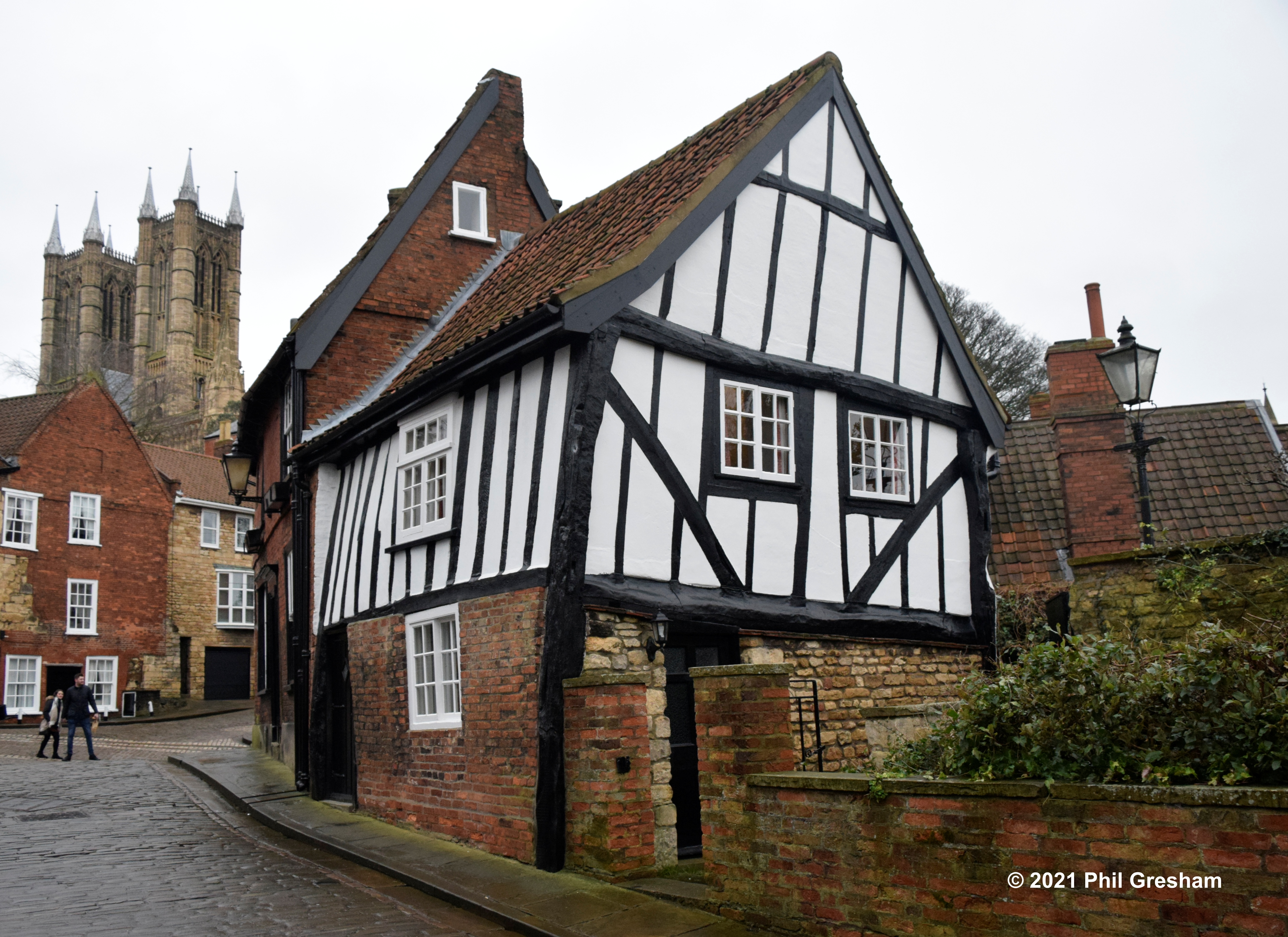
The Crooked House


The Crooked House at the top of Michaelgate is well known, and is probably one of the most photographed buildings in Lincoln after the Cathedral, Castle and Stonebow.


This house looked like any other terraced house until the 1930s. At that time there was a major slum clearance throughout the city; in areas close to the factories and foundries of the Waterside, even Jews Court was in danger of being lost until it was rescued by the Lincolnshire Architectural and Archaeological Society (now The Society for Lincolnshire History and Archaeology).  In late 1933, a demolition order was issued for numbers 34, 36, 38 and 40 Michaelgate. When demolition of number 40 began it was discovered there was a half-timbered building behind the brick façade.  The owner of the house asked the council to rescind the demolition order.  Permission was granted by the Minister of Health subject to it not being used for human habitation.   

Dating from the 16th century, the house has 18th, 19th, and 20th century alterations. Dressed stone and brick, with close studded first floor with rendered nogging. Pantile roof. 2 storeys, 2 bays. Street front has a replica plank door to the left, and to the right, a 2-light sliding sash. Above, to the right, a C20 casement. South gable has a 20th century door to left and a 20th century casement above. Gable framing has curved braces and corner posts. (https://historicengland.org.uk/)

The house was acquired by Lincoln Council and renovated to its original style; it became one of the oldest council houses in England.  The house is still owned by the City of Lincoln Council and managed by the National Trust.

Click here to read about the interior of the house


Dernstall House


Dernstall House dates from the late 15th century, altered in the 17th and 18th centuries and restored in 1969.

The Cardinal's Hat


The Cardinal's Hat building is thought to be named after Cardinal Wolsey and dates from the 15th or 16th century.  Originally the home of the Grantham family, after which the nearby street was named later becoming an inn, it remained so until the early 19th century, when it was known as the Cardinal's Cap.  In 1872 it was the premises of Albert W Hall, grocer & baker, established in 1790.  Over the years it became a furniture store until the St John's Ambulance made it their county headquarters and the building was renovated in 1952.

​After almost 200 years it is now a public house again.


High Bridge


High Bridge on Lincoln’s High Street is the oldest surviving bridge with buildings on, in this country. It marks the spot where the Roman Ermine Street crossed the Witham by way of a ford; a bridge was built in the 2nd century.

The river was much wider than today and High Bridge was thought to be made of five arches; today only one arch remains.

There were many bridges like High Bridge in the middle ages; London Bridge for example, but all the others have long since disappeared; the only other bridges with buildings on them in England are Frome Bridge dating from 1667, and Bath’s Pulteney Bridge of 1773.


The Green Dragon


The Green Dragon is a four-gable half-timbered building dating from the 16th century.  It was probably built for a wealthy Lincoln merchant, and bought by the Common Council of the City of Lincoln from Thomas Grantham in 1569.  By 1624 it was known as the Great Garrettes, it remained as tenements and shops until the 1950s.

There was a major restoration of the building in the late 1950s, and the Green Dragon public house moved here from an adjoining brick-built building on the east side of the present building.


The Treaty of Commerce


The Treaty of Commerce is one of the most central pubs in Lincoln; many other central pubs have closed since the 1970s.  The name is said to have come from an 1860 trade treaty with France.  It was named Treaty of Commerce in 1867.  Owned by Ind Coope from 1911.  The plaster and timber frontage was added in 1926 for Ind Coope.

Became O'Donoghues Irish Bar in the 1990s, renamed Honest Lawyer from October 2000 to November 2001.  Reverted to The Treaty of Commerce in November 2001, when it was acquired by Bateman's Brewery


Whitefriars House

By Alfred Ernest White c1880 - Art UK,
Public Domain, https://commons.wikimedia.org/w/index.php?curid=45247605

Sadly only one wall now exists of Whitefriars House, but it has been protected from the elements by the building on the opposite side of Akrill's Passage.

It was called Whitefriars because it was once thought to be part of the Whitefriars Priory; but during the re-development of the Midland Station the remains of the priory was discovered.

By Richard Croft, CC BY-SA 2.0,
https://commons.wikimedia.org/w/index.php?curid=13622278

The original building dates from the 15th century and it has suggested that it could be the former vicarage of St Mary le Wigford.  It was restored in the late 20th century and a shop front added.

It is difficult to get a good photograph of the building so I have used a photograph from when the neighbouring building was rebuilt.


Atton Place


Atton Place on Eastgate is one of the oldest houses in Lincoln.  First mentioned in the accounts of the Dean and Chapter in 1441, it was originally a single storey building.  The building was included in a Parliamentary survey of 1649.

Reputedly named after Canon John de Aton (or Acton), Prebendary of Welton Ryval from 1329-1351. who lived here 1324-1326.

The building was re-fronted in a typical Georgian style in the late 18th century, an extra floor was added in the late 19th century, the house was made up of the properties visible in the image, but divided into two properties about the same time.

The building remained a priests' house for many years.  

It later became the County Assembly Rooms and a ladies boarding school, the large ground floor room was cleared for balls and other functions, the room was 40 ft long by 20 ft wide, entered through the central doorway at the front. The County Assembly Rooms moved in 1744 when the new building opened in Bailgate.  The school closed sometime later and then became the Judges Lodgings until 1810.  

For most of the next 100 years the house became a private house, Since the second decade of the 20th century, it has been home to a group of surgeons, an architect and interior designer, and now an estate agent.

People who lived and worked here 
In 1840 it was the home of 31-year-old Harriet Bainbridge's Boarding and Day Academy, her father Thomas' Academy was situated at 1 Michaelgate, her brother George founded the Bainbridges department store in Lincoln High Street.  Harriet married Richard Waddington, an Ironmonger, in early 1841 and later moved to 3 Guildhall Street.  Harriet died in April 1885.

In 1851 Henry Moss, Town councillor silk mercer & master employing 17 hands, lived here with his wife Louisa, 5 children, nephew, 10 employees and 3 servants.  

1857 Miss Thomas - Preparatory school for young gentlemen, formerly at 31 The Park

1932 Douglas Darbyshire, surgeon